The Shift Worker Kitchen Audit
Before any cooking happens, this module walks through an honest assessment of the constraints that actually define your situation. Locker dimensions, break room equipment, reheating access, and the physical journey your food takes from home to consumption point all affect what will work for you.
Most meal prep advice is written for people with full kitchen access and a conventional schedule. This module starts from where shift workers actually are. You will map your specific constraints and use that map to make decisions in every subsequent module.
Topics covered
- Assessing your storage and reheating options at work
- Understanding how your schedule pattern affects prep timing
- Identifying which constraints are fixed and which are flexible
- Building your personal prep profile before any cooking begins

Proteins and Grains That Hold Up
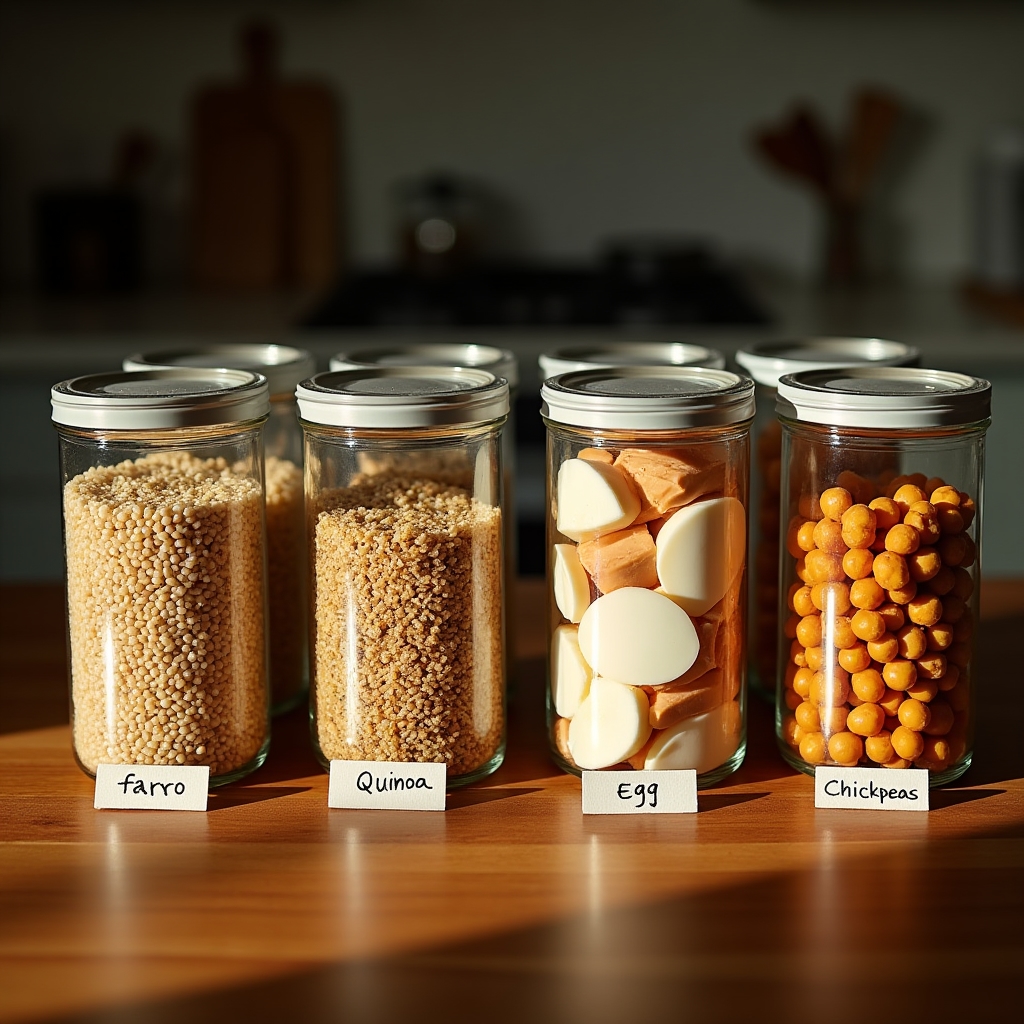
This module covers the food science of how different ingredients behave over time in a sealed container. It is not a list of approved foods. It is an explanation of why certain proteins maintain texture and safety longer than others, and how different carbohydrates respond to the temperature changes and moisture levels inside a lunchbox.
Understanding these principles lets you make informed ingredient choices based on your specific situation. The shift worker eating at hour four of a shift has different constraints than the one eating at hour ten. This module helps you understand the difference and plan accordingly.
Topics covered
- How proteins behave at ambient temperature over time
- Starch retrogradation and why it matters for grain selection
- Moisture migration and how it affects texture in sealed containers
- Temperature safety windows for common lunchbox foods
- Which ingredient combinations create problems and which work well together
The Two-Hour Prep Session
This is the operational core of the course. A full walkthrough of how to sequence cooking tasks so that five days of food is ready in a single session. The module covers timing charts, oven stacking logic, parallel task management, and the specific order of operations that makes the two-hour window realistic rather than aspirational.
The session is designed around a single day off. It does not require a full weekend. It does not assume you have help. It works with one person, one standard kitchen, and the time between waking up and needing to do anything else.
Topics covered
- The full sequencing logic of a two-hour prep session
- How to use oven and stovetop simultaneously without chaos
- Cooling and storage timing to maintain food quality
- Adapting the session when you have less time than planned

Lunchbox Architecture
A lunchbox is a system, not just a container. Container selection, layering order, sauce placement, and packing technique all affect whether food arrives at your break in good condition. This module covers the physical design of your meal-in-transit with the same level of attention the cooking modules give to the food itself.
Different shift lengths and storage conditions call for different approaches. A meal that will be eaten at hour four needs different packing than one that will sit until hour ten. The module covers both scenarios and the principles behind each decision.
Topics covered
- Container types and their trade-offs for different foods
- Layering logic to prevent sogginess and flavor transfer
- Sauce and dressing placement for different eating scenarios
- How to pack for a twelve-hour shift with multiple eating windows

Chrononutrition for Shift Workers
Chrononutrition is the study of how eating timing interacts with circadian biology. For people with conventional schedules, the research has limited practical application because their eating naturally aligns with their circadian phase. For shift workers, the misalignment between circadian rhythm and eating timing is significant and the research findings are more directly relevant.
This module presents what published studies show about eating before and after night shifts, how circadian misalignment affects metabolic processes, and how shift workers can use that information to make informed decisions about their pre-shift and post-shift meals. This is educational content drawn from published research, not medical advice.
Topics covered
- An overview of chrononutrition research and its relevance to shift work
- What the evidence shows about eating before a night shift
- Post-shift meal considerations based on circadian biology research
- How to translate population-level research into personal meal timing awareness
- The limits of what research can tell an individual without clinical assessment

Adapting the System
Any system that only works when conditions are perfect is not a system. This module addresses the real-world disruptions that shift workers encounter: schedule rotations, unexpected overtime, travel for work, changes in what is available at the store, and weeks where the planned prep session does not happen.
The module teaches how to apply the principles from the earlier modules in compressed or constrained versions of the prep session. A thirty-minute version. A travel version. A rotation-week version where your days off shift by two days without warning. The goal is a system that remains useful even when the week does not cooperate.
Topics covered
- Compressed prep sessions for weeks when time is limited
- Adapting the system to rotating shift patterns
- Maintaining food quality during travel or extended away-from-home shifts
- What to do when the full prep session is not possible